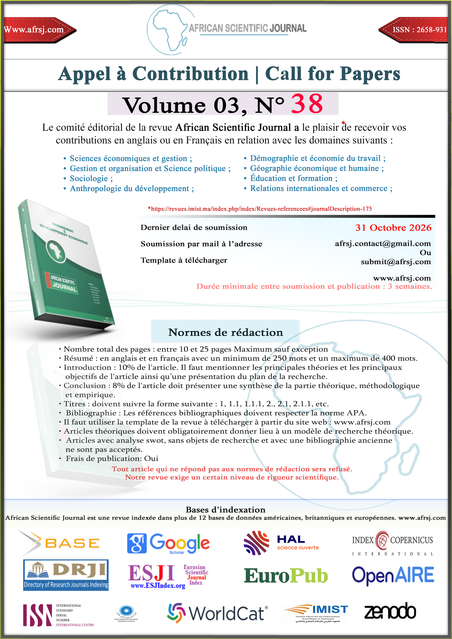
African SJ | Call for paper | Volume 03, N°38

African Scientific Journal (ASJ)
1. General Principle
African Scientific Journal encourages authors to make the research data associated with their articles available in order to promote transparency, reproducibility of results, and the advancement of scientific knowledge.
Authors are encouraged to share datasets, software code, research materials, and experimental protocols whenever possible.
2. Data Deposition
When appropriate, authors are encouraged to deposit their research data in recognized institutional or subject-specific data repositories.
Authors should clearly indicate in their manuscript:
where the data are stored,
how the data can be accessed,
and any conditions governing access to the data.
3. Data Availability Statement
All published articles should include a Data Availability Statement specifying:
whether the data supporting the findings are publicly available,
where and how the data can be accessed,
or the reasons why the data cannot be made publicly available.
4. Exceptions to Data Sharing
In some cases, research data cannot be shared publicly due to:
ethical restrictions,
privacy concerns,
legal limitations,
or confidentiality agreements.
In such situations, authors must clearly state the reasons for these restrictions in the Data Availability Statement.
5. Long-Term Data Archiving
The journal encourages authors to archive their research data in platforms that ensure long-term preservation and accessibility of scientific data.
Research data associated with published articles should remain available for as long as possible to support verification and reuse of the research.
6. Author Responsibility
Authors remain responsible for the accuracy, integrity, and accessibility of the data they share.
The journal may request access to the underlying data when necessary to verify the results reported in the manuscript.
Submit your papers by E-mail
All submitted papers in ASJ are checked by ithenticate antiplagiarism delivred by National Centre for Scientific and Technical Research - CNRST





Centre de Recherche et de Promotion en Gestion des Institutions de Santé - RDC
Centre National pour la Recherche Scientifique et Technique